Pedicab Advertising vs Mobile Billboards: Which Has Better ROI?

_Updated June 2026._
For San Diego conventions and dense downtown events, pedicab advertising delivers a better ROI than mobile billboard trucks — roughly a $1–$4 CPM versus $8–$15, plus access to the pedestrian-only zones where event crowds actually gather. Mobile billboard trucks still win for highway and citywide awareness. Here's the side-by-side so you can pick the right format for your campaign.
Pedicab advertising vs mobile billboards at a glance
| Factor | Pedicab advertising | Mobile billboard truck |
|---|---|---|
| Typical cost | $250–$500 per pedicab/day | $1,500–$3,000 per truck/day |
| Daily impressions | 30,000–75,000 per pedicab | 30,000–50,000 per truck |
| CPM (cost per 1,000) | $1–$4 | $8–$15 |
| Pedestrian-zone access | Yes — closed streets, plazas, Gaslamp | No — vehicle roads only |
| Dwell time | 8–15 min per rider; 8–12 sec per passerby | 3–5 sec in passing traffic |
| Provides a service | Yes — free branded rides build goodwill | No |
| Best use case | Conventions, festivals, dense downtown | Highways, suburban and citywide reach |
Pedicab advertising and mobile billboard advertising are both out-of-home (OOH) formats, but they reach people in very different ways.
How each format works
Pedicab advertising
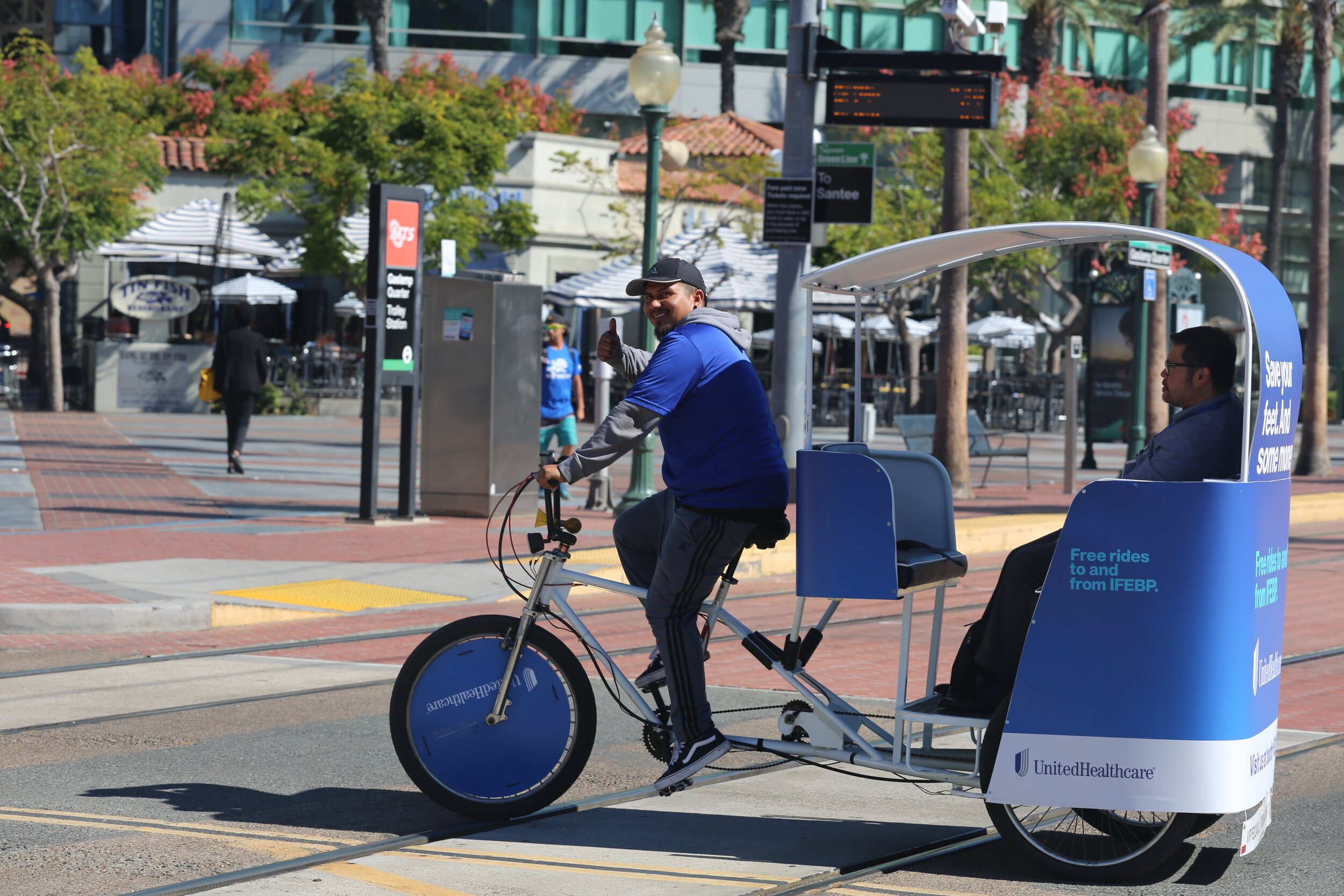
A wrapped electric pedicab is a moving, eye-level billboard that travels through the densest pedestrian areas — the Gaslamp Quarter, the Embarcadero, hotel corridors, and the streets around the San Diego Convention Center. Because pedicabs operate in pedestrian zones and can sponsor free rides, your brand reaches people where they walk, wait, and gather — and the impression lands as a favor, not an interruption.
Mobile billboard trucks
📚 Get Our Free Convention Marketing Guide
Event calendars, ROI case studies & pricing breakdowns from 250+ campaigns.
A mobile billboard truck is a flatbed or box truck carrying a large printed or LED panel that drives fixed routes. It covers ground a pedicab can't — freeways, arterials, and spread-out suburban areas — but it's confined to vehicle roads, can't enter closed streets or convention plazas, and offers no rider service. Impressions are brief, captured from passing traffic.
Cost and CPM: why pedicabs win on efficiency
At $250–$500 per pedicab per day versus $1,500–$3,000 for a truck, a pedicab fleet buys far more street-level presence per dollar. Pedicabs also deliver a CPM of roughly $1–$4 — among the lowest in out-of-home — compared with $8–$15 for mobile billboard trucks. During a convention, when foot traffic surges, the effective pedicab CPM drops even further.
Which one wins for conventions and events?
Pedicabs, decisively. At events like Comic-Con and conferences at the San Diego Convention Center, the crowd is on foot in pedestrian-only zones a truck simply cannot reach. VIP Pedicab has run convention campaigns for HBO, Disney, Cisco, CBS, Fox, and ABC — see the case studies for real deployments and results.
Which one wins for citywide brand campaigns?
Mobile billboard trucks. If your goal is broad, drive-time awareness across freeways and suburban San Diego — not a specific event or walkable district — a truck's range is the advantage. For most event and downtown campaigns, though, pedicabs deliver more engaged impressions per dollar.
The bottom line
Choose pedicab advertising for conventions, festivals, and dense downtown campaigns where engagement and pedestrian-zone access decide the outcome. Choose a mobile billboard truck for highway-scale citywide awareness. Many brands do both — pedicabs for the event, a truck for the surrounding metro.
Want a side-by-side recommendation for your specific campaign and budget? Request a free quote and we'll size the right format and fleet.